

The Resentment you Carry

How We Pay the Price for Our Pain
Stop Living Wounded: Resentment
Have you ever discovered that someone who is no longer in your life is still influencing how you live it? They may have moved away, the relationship may have ended, or years may have passed since the injury occurred. Yet something happens in the present and suddenly you are responding not only to today, but also to yesterday.
That is one of the difficulties with resentment. We often think resentment means remaining visibly angry with someone. Sometimes it does. But resentment can also be quieter. It can become part of the lens through which we interpret people, relationships, authority, and even God.
The Human Experience
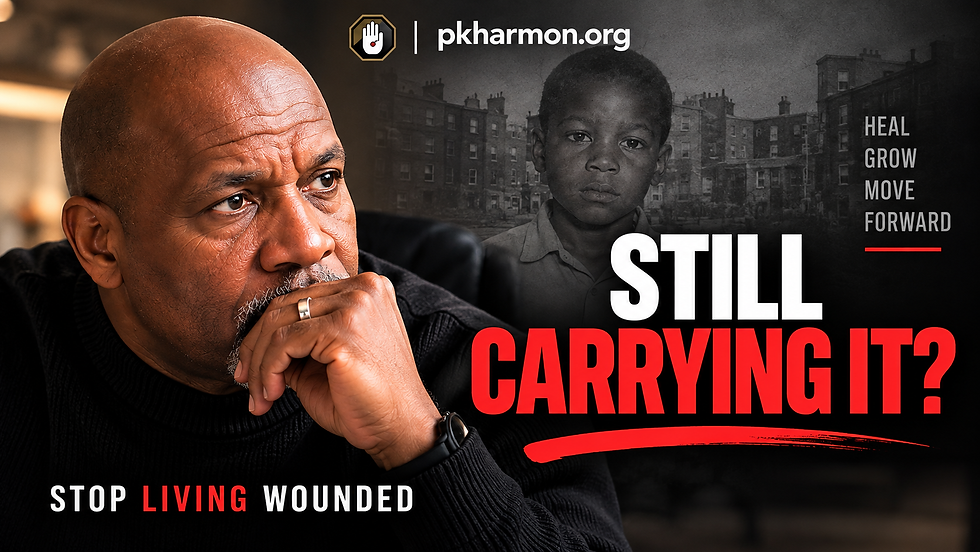
I grew up in the Vineyard Housing Projects in Benton Harbor, Michigan, under a physically abusive stepfather we called Big Joe. He was an enormous man, and as a child I learned very quickly what his authority could mean. Fear was not an abstract psychological concept in our house; it was something I experienced.
Years later, I began recognizing that experiences like those do not politely remain in childhood. We carry lessons from painful environments long after we leave those environments. In Stop Chasing the Wind, I wrote about how my experiences with Big Joe and later with a tough Army drill sergeant shaped my relationship with authority. Eventually, I had to examine how those experiences even influenced my early understanding of God. I wasn't simply remembering my past. Parts of my past had helped teach me how to interpret my present.
A. Resentment Can Become a Lens
Pain teaches. Unfortunately, it doesn't always teach the right lesson. Betrayal can teach us that nobody is trustworthy. Abandonment can teach us that people always leave. Rejection can teach us that we are not enough. When those conclusions remain unexamined, we may enter new situations expecting old outcomes.
This is why resentment can cost us relationships with people who never caused the original wound. A new friend is not the friend who betrayed you. Your current spouse is not necessarily the person who abandoned you. Your present pastor is not automatically the leader who hurt you. Yet unresolved pain can cause us to respond as though the cast changed while the story remained the same.
B. Resentment Keeps the Past Emotionally Present
There is a difference between remembering something and continuing to live from it. Healing does not require pretending something didn't happen. In fact, I've come to believe that naming pain honestly is part of healing. But remembering an injury and allowing that injury to continually determine our reactions are different things.
Sometimes the intensity of our response to a present situation gives us a clue. Someone forgets to call, disagrees with us, corrects us, or fails to acknowledge something we've done. The situation may legitimately bother us, but when our emotional response seems much larger than the event, it may be worth asking whether something older has entered the room.
C. Resentment Can Become Part of Our Identity
One danger of carrying a wound for a long time is that eventually we can stop saying, “This happened to me,” and begin living as though, “This is who I am.” There is an important distinction. What happened to you matters. It may have shaped you profoundly. But your wound does not deserve the authority to become your identity.
Psychologically, rumination can keep us mentally returning to distressing experiences. Spiritually, we face another danger: allowing what someone did to us to speak more loudly about who we are than what God says about us.
The Pastoral Turn
Psalm 147:3 says that God “heals the brokenhearted and binds up their wounds.” I appreciate the honesty of that image. Scripture doesn't deny the wound. God doesn't ask the wounded person to call an injury something else simply because acknowledging it is uncomfortable. Healing begins with truth, but healing also means the wound doesn't get the final word.
My past is part of my story. Big Joe is part of my story. The Vineyard Projects are part of my story. The difficult parts don't need to be erased for healing to occur. What changes is the authority those experiences have over the person I am becoming.
So How Do You Move Forward?
Start by asking a different question. Instead of only asking, “Who am I still angry with?” ask, “What am I still carrying because of what happened?” Those are not necessarily the same question.
Then separate the event from the conclusion you formed because of it. “Someone abandoned me” describes an experience. “Everyone eventually leaves me” describes a belief. “Someone rejected me” describes an experience. “I am unworthy of love” describes an identity conclusion. Finally, pay attention to where yesterday may be interpreting today. The goal isn't to distrust every emotion. It is to become curious enough about your emotions to understand where they are coming from.
Closing Thought
I have learned that pain is not always something we simply “get over.” Sometimes healing requires understanding what the pain taught us and deciding whether those lessons are still true. The person who wounded you may be gone. The season may be over. The circumstances may have completely changed.
Now comes a harder question: Does the wound still get a vote in how you live today? Healing doesn't require changing your history. It requires reaching the place where your history no longer gets to quietly determine your future. That's part of learning to Stop Living Wounded.
Connect:


Comments